It was 7 PM on a weekday, I knew I needed to hit the gym. My body kept telling my brain to stop working. But my drained eyes were still staring at my laptop screen, waiting for an AI agent to return a result. When it did, it asked me a certain list of options for its next action. Without a second thought, I chose the first option, which was recommended by the agent, not because I lacked patience, but because my brain was exhausted. At 8 PM, I could finally wrap up work and grabbed my backpack to go to the gym. After I had dinner at 9:30 PM, I could not look at the computer screen anymore to do my side project or learn new stuff. The reason is not that I am lazy, with the habit of switching between AI agents during office hours in the day, I could not focus on the task for 15 minutes straight. I was continuously looking for other things to do because I was afraid that I would miss that.
If my story reflects yours as well, then you are not alone.
Traditionally in the software development lifecycle, if you want to produce a quality output, the best way to do it is to block yourself a good chunk of time to do it without any interruption. In 2026, this is no longer true. AI agents boost productivity by making a journey to accomplish a task look seamless. So some AI influencers out there suggest that we could run these agents in parallel to get the most results with the least time spent.
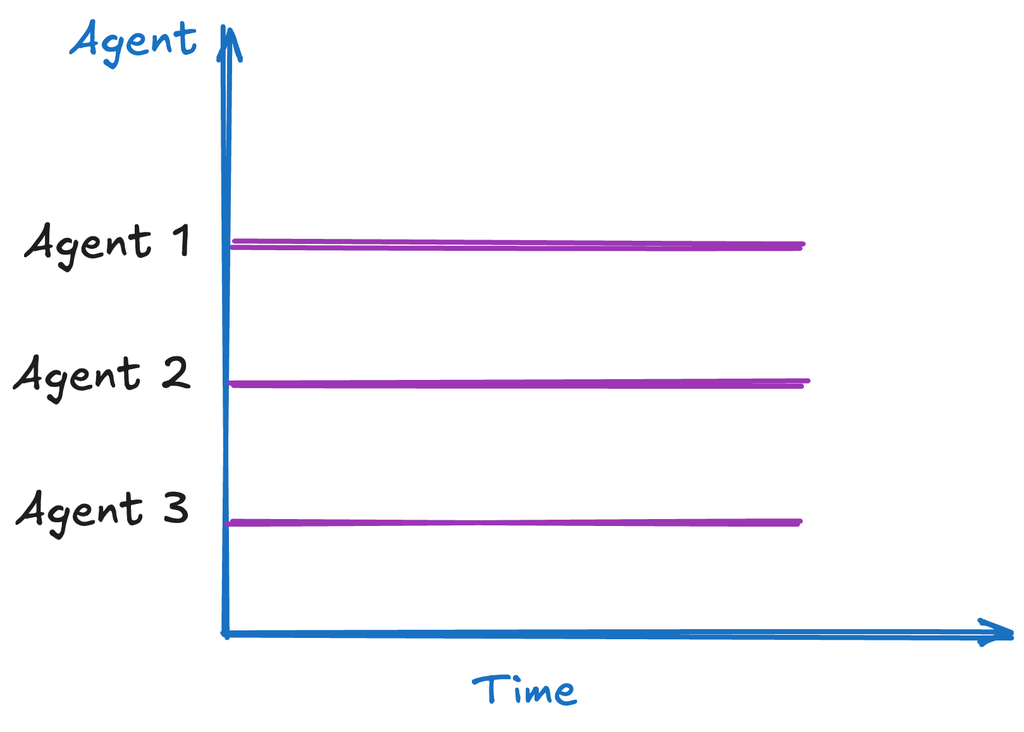
But here is the catch: while AI agents could run in parallel, the human brain works best in a single-task environment. For that reason, I think concurrency is the suitable word to illustrate human cognitive ability here.
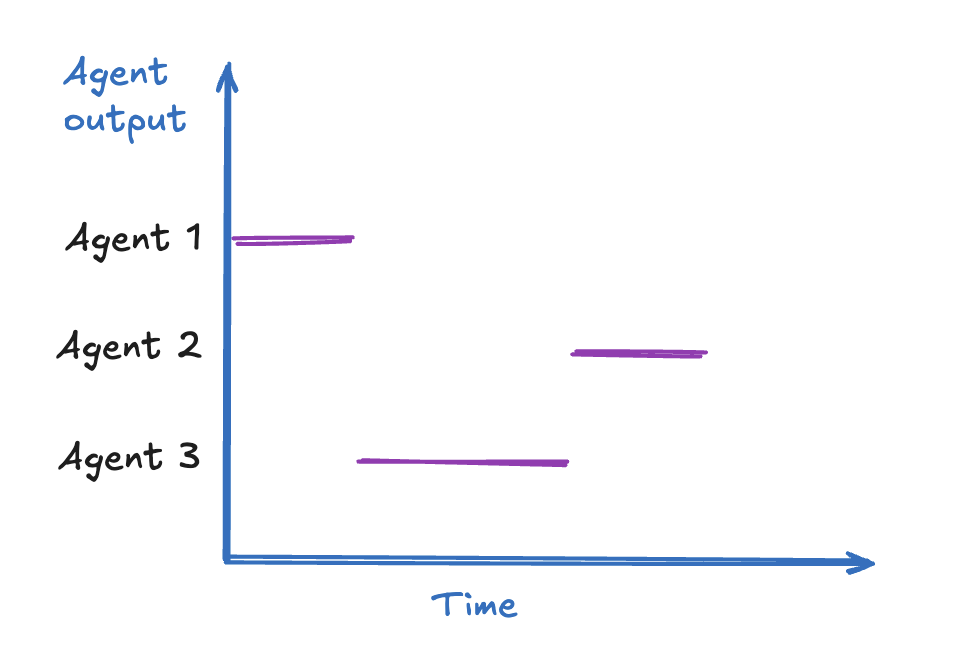
The vertical axis is the outputs of agents, while the horizontal axis is the time consumed by humans to review those outputs. This is the narrative that Silicon Valley promotes for the current software development lifecycle. A software engineer who could manage a swarm of agents – just like an engineering manager. Under a good engineering manager, a software engineer does not often need to be managed directly for every single action. While unlike engineer manager, AI agents need to be babysat. This is where it does not work for me and makes my brain performance decrease.
When I ask an AI agent to perform a specific task, take Claude Code for example, it often looks like this:
- runs a variety of tools to get the context
- asks itself a question about a related topic.
- returns a bunch of sentences explaining its thinking (cus it has to reason) and ends up with its suggestion at the end of the message.
My regular AI agent chatbox session lasts around 10 messages, so you could imagine we need to read all of these inputs displayed in the chatbox 10 times. Multiply by 5 agents probably running in parallel. Reading AI agent output is 50 times in total, and you probably do it in 15 minutes window. That is when it does not apply to me.
So I have diagnosed my problem; how can I reduce the read workload I need to do every day?
- Simplify words
- I am using asd-ste100 skill for this. This skill helps an AI agent to simplify English technical words. ASD-STE100 is used in aerospace and space to reduce misinstructions that could cause aircraft to kill the wrong people. You can find it here: https://github.com/danyuchn/asd-ste100-skill
- Read the bottom first
- Under the hood, LLM needs to reason for its output, that why you see a bunch of coherent paragraphs in the beginning just to restate the current problem. Its final answer to your prompt could be placed at the bottom of its answer.
- Draw diagrams:
- I often prompt AI agents to draw mermaid diagrams or an HTML page to visualize things. It helps a lot to connect dots in your thought. This is a great way to reduce reading words generated by LLMs.
- Buy a microphone:
- Typing on a keyboard is pretty slow. At the current pace of AI agents’ outputs, interacting with voice typing is most effective. This is my new type of keyboard nowadays.
I hope it helps.
Cover image: https://unsplash.com/photos/a-computer-generated-image-of-a-brain-surrounded-by-wires-CFSJUUb_Q-Y